Story as a Path Back to Community
Thousand Oaks Remembers was born out of the dual tragedies of November 7 and 8, 2018 — the Borderline Bar and Grill shooting and the Hill and Woolsey fires — events that shook this community to its core and, in the same breath, revealed its extraordinary capacity for compassion and care. In the years since, like so many communities across the country, we have experienced real division, shaped by a global pandemic, a polarizing political climate, and the quiet drift that follows when people stop gathering. Story as a Path Back to Community exists to help this community find its way back to one another — through storytelling.
What this project is:
Story as a Path Back to Community is an 11-month grant-funded initiative of Thousand Oaks Remembers, made possible through Sacred Discoveries. Through facilitated story circles, storytelling workshops, and community events, we are bringing people across the Conejo Valley back into genuine relationship with one another — rebuilding the relational trust that holds a community together not just in moments of tragedy, but in ordinary time. The project centers the voices of young adults, those who were teenagers in 2018 and have been carrying those events into their adult lives, while creating intergenerational spaces where their stories can be received by the broader community.

Story circles:
Story circles are small groups — six to ten people, a trained facilitator, and guided prompts — that create space for people to share lived experiences and listen deeply to one another. Not debate. Not processing. Just the simple, powerful act of hearing someone else's story and being heard in return. When people share lived experience (not opinions, not positions) something shifts. Defenses soften. The person across the room becomes a person again. People leave knowing something true about someone they didn't before. Story circles are available in two formats:
1. Single session (90 min – 2 hrs) — A one-time gathering that moves through three movements: arrival and grounding, story sharing, and looking forward. Good for a community event or an introductory experience.
2. A 4-week series (60–90 min per session) — The same small group meets weekly over four weeks, building trust and depth across the arc. Deeper trust, deeper stories.
Both formats are available in faith-based and secular versions, adaptable to congregations, nonprofits, civic organizations, and neighborhood groups.
Storytelling workshops:
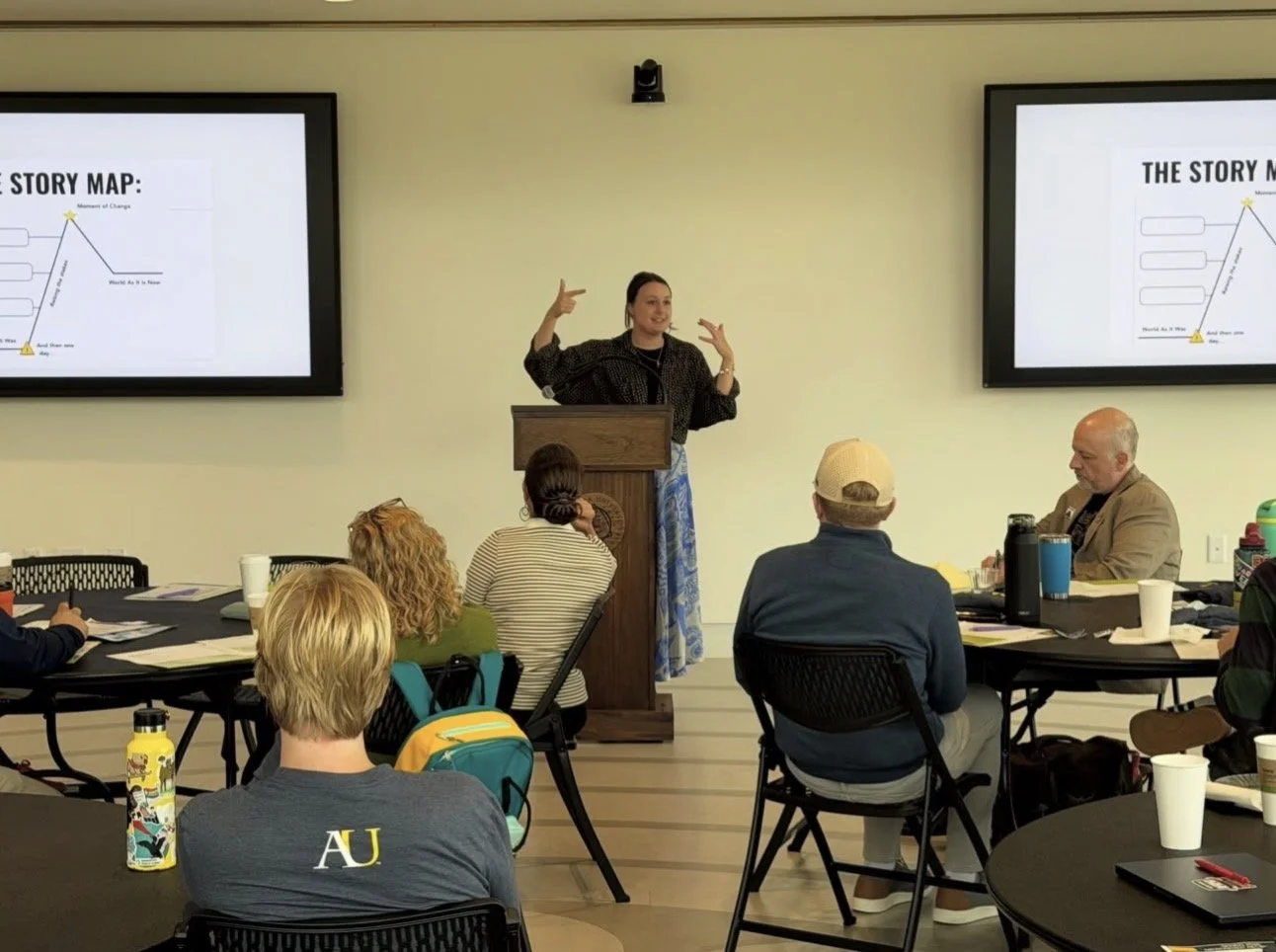
Our storytelling workshops teach people how to find and shape the stories they're already carrying. In a single 2–3 hour session, participants learn practical tools for oral storytelling — how to find the specific moment inside a larger experience, how to structure what they want to say, how to bring another person into the story, and how to end with something true rather than something tidy. Workshops are offered for:
Survivors and community members connected to November 2018 — for those who have a story they want to tell but don't know how to shape it, or who feel like their experience is too complicated or too small to share.
Congregations/Faith Communities — as a launching point before story circles begin, giving participants a shared vocabulary and the confidence to share.
Nonprofits and civic organizations — helping communities build the capacity to tell their own story of resilience and care.
Participants leave each workshop having shaped one story they could share in a circle, record for the podcast, carry into a community event, and an empowered sense of their place in the life stories that are still unfolding.
How to get involved:
Host a story circle or storytelling workshop: We bring the facilitator, the prompts, and the structure. You bring the people and the space. A two-hour commitment that leaves people more connected than when they arrived. This works in a congregation, a conference room, a nonprofit meeting space — anywhere people already gather.
Join an upcoming event: Story circles and workshops are open to community members. Reach out through our Connect page to hear about upcoming gatherings in your area.
Share your story: If you have a story from November 2018 or its aftermath, of being upheld by this community, or of uplifting someone else, we want to hear it. Stories may be recorded for the podcast, shared on the website, or simply held as part of the community archive. Reach out through our Connect page to learn more.
The Team:
Shannon Savage-Howie, Project Director Facilitator with over 20 years of community-based work in the Conejo Valley. Led Thousand Oaks Remembers from its beginning. Brings experience in storytelling, facilitation, ministry, and community-based healing work.
Pastor Tom Stephan, Community Partner Pastor at Monte Vista Presbyterian Church in Newbury Park. Bringing pastoral leadership, deep community relationships, and experience guiding congregations through complex conversations.
Pastor Kirk DeWitt, Associate Care Pastor at Calvary Community Church in Westlake Village and former Lead Pastor of Conejo Church in Thousand Oaks. Kirk also serves as Chairman of the Board of James Storehouse, a nonprofit serving families across Ventura and Los Angeles Counties. He was part of the original Thousand Oaks Remembers story circles and brings deep pastoral roots and community relationships to this next chapter of the work.
Molly Maurer, A Borderline survivor and trained Peer Support Specialist with extensive experience in survivor advocacy and trauma-informed care. Molly has been deeply active in the community of survivors that has formed since November 2018, and brings both lived experience and professional expertise to this project — along with a belief that every person deserves to be heard, supported, and empowered.
Michael Morrisette, Community Advisor Father of one of the Borderline victims. Bringing personal connection, lived perspective, and grounding to the work — ensuring it remains rooted in the real experience of those most affected.